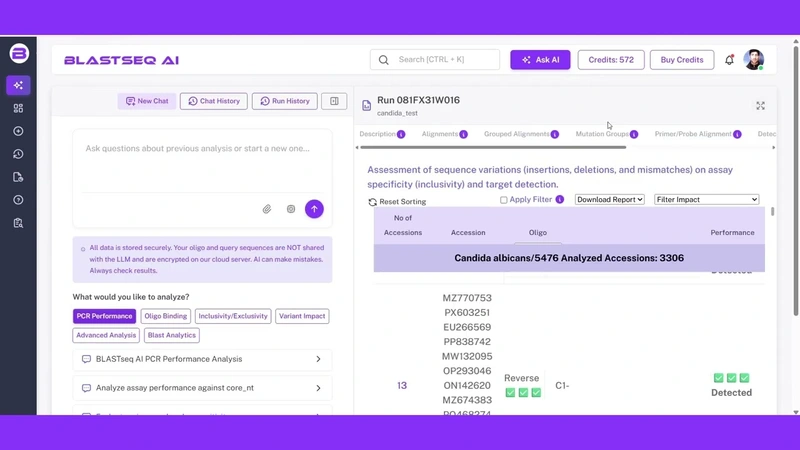
Analytical specificity is a required performance characteristic for molecular assays: demonstrate the assay detects what it claims across the diversity of the target, and doesn't detect what it shouldn't. The problem is that the diversity keeps growing, and most of it never arrives as a culturable isolate, a reference material, or a characterized sample.
Read more
FDA has acknowledged this directly. In its special controls guideline for nucleic acid–based tuberculosis assays, the Agency states that in silico testing may be acceptable as an alternative for inclusivity testing for strains that are difficult to study. Across a growing set of molecular device classifications — including point-of-care and over-the-counter classifications finalized in mid-2026 — FDA writes the method into the special controls by name: a documented protocol for the continuous monitoring, identification, and handling of genetic mutations and novel isolates or strains, through regular review of published literature and periodic in silico analysis of target sequences to detect possible mismatches.
For laboratories, the same evidence sits under a different regulator. Establishing performance specifications for an LDT under CLIA requires analytical specificity, including interfering substances — and the same availability problem applies.
The logic holds outside infectious disease too. A carrier screening or oncology panel can lose an allele to a population SNP sitting under a primer binding site, and report a false homozygous result — a risk the ACMG and AMP standards for CFTR testing name explicitly. A veterinary or food-safety assay faces the same strain diversity with less reference material available. An NGS amplicon panel with four hundred primer pairs carries cross-hybridization risk no single-primer BLAST search will surface.
And it isn't a one-time exercise. Sequence databases grow continuously, and an assay evaluated against last year's database has not been evaluated against this year's. Recommended variant sets change too — ACMG replaced the 23-variant CF carrier screening panel with 100 variants in 2023, and every panel rebuilt to match needs its primer coverage rechecked. BLASTseq AI is built for the recurring version of this work: run it, score it, keep the record.
BLASTseq AI supports your analytical specificity assessment and monitoring activities; it does not discharge any regulatory obligation. In silico findings guide assay review and inform appropriate wet-lab evaluation. They do not replace laboratory validation. BLASTseq AI is not certified, approved, endorsed, or recognized by FDA, CMS, CAP, ACMG, AOAC, or any regulatory, professional, or accrediting body.